Laboratory tools / 02
Peptide molecular
weight calculator.
From amino acid sequence to molecular formula and mass. A free workspace for a single peptide chain with clearly defined chemistry.
Read the method & scope02 / Understand the mass
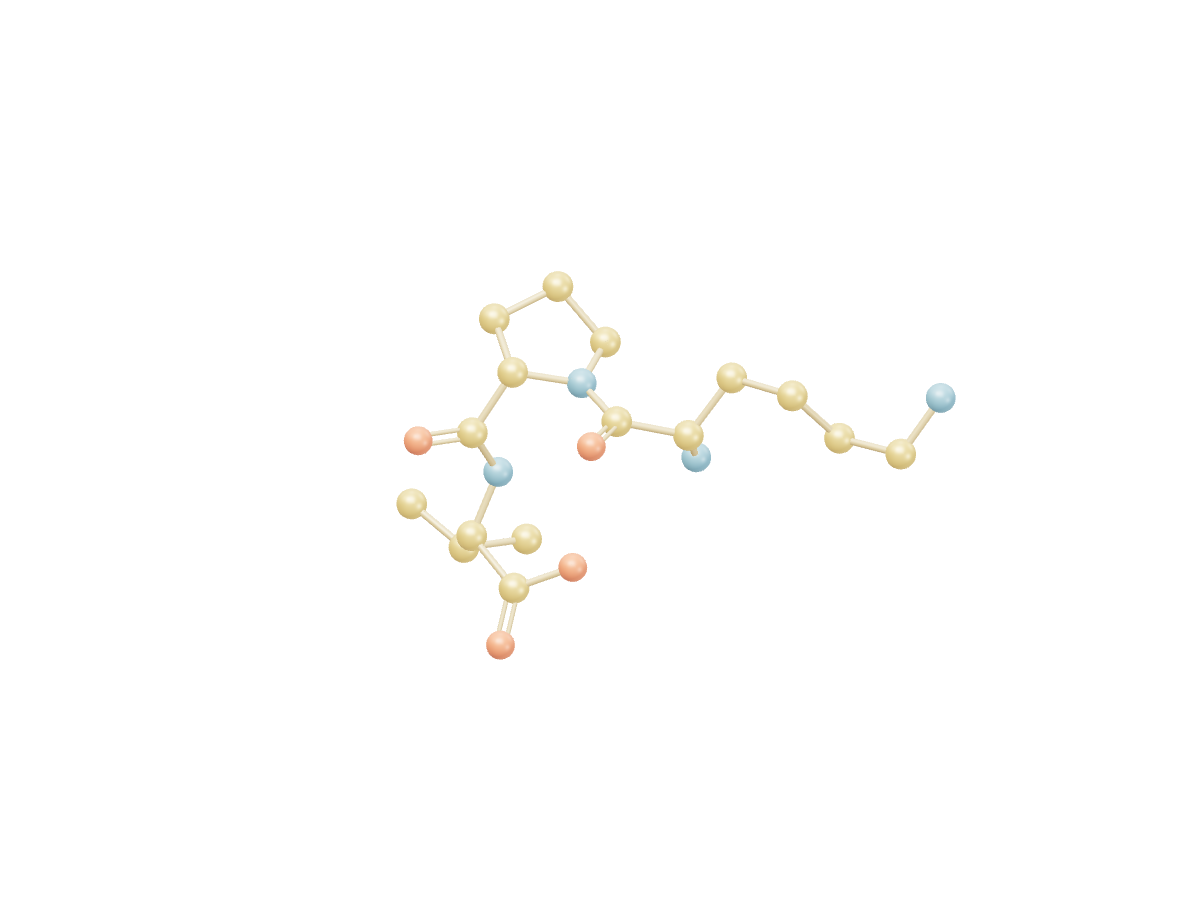
Illustrative reference peptide. Independent of your inputs and any report or batch results.
A sequence.
A defined mass.
Enter your sequence and chemical form to see the molecular formula, average mass and monoisotopic mass together.
The working, made visible
Know what
you’re calculating.
Molecular weight depends on the chemical form. A sequence-derived value does not establish the composition or peptide content of a supplied batch.
How is peptide molecular weight calculated?
The calculator sums the elemental formulas of the amino acid residues and adds one H₂O for the two ends of a single linear chain. Each peptide bond is already accounted for in the residue formulas.
- Free peptide
- Sum of residue formulas + H₂O
- N-acetylation
- Add C₂H₂O
- C-amidation
- Add HN; subtract O
- Each disulfide bond
- Subtract H₂
Average molar mass uses the Unimod average atomic masses. Neutral monoisotopic mass uses its masses for the most abundant naturally occurring isotope of each element. It is not a charged-ion m/z prediction.
Supported chemistry
The 20 standard amino acids, a linear peptide backbone, optional N-terminal acetylation, optional C-terminal amidation and a specified number of intrachain cysteine disulfide bonds.
The tool does not calculate nonstandard residues, other modifications, head-to-tail cyclisation, linked chains, metal complexes, salts, counterions or water of hydration. Do not substitute a standard residue for an unsupported one.
Confirm the actual material’s chemical form and mass basis before using a result for solution calculations. HPLC area purity is not a direct measure of peptide content.
Understand purity vs contentWorked example / KPV
Three residues. C₁₆H₃₀N₄O₄.
KPV with a free N-terminus, free C-terminal acid and no disulfides gives an average molar mass of 342.4338 g/mol and a neutral monoisotopic mass of 342.226706 Da using this table. Acetylating its N-terminus adds 42.0367 g/mol to the average mass. This example describes that defined free-peptide form, not a catalogue batch.
Reference data & calculation notes
Residue elemental compositions: Unimod amino acid data. Atomic masses: Unimod mass table. Terminal adjustments: Acetyl and Amidated. Small differences between calculators can follow from atomic mass tables and rounding.
For laboratory research calculations. This tool does not provide dosing, administration instructions or product acceptance decisions.